
As many of you, my readers know, I have been teaching at business schools and universities around the world for the past 25 years alongside starting up and running companies.
With that experience I believe I have seen most of the best and most of the worst when it comes to business schools both in terms of management, but also in terms of how students are tricked into believe that choosing an accredited business school is a safe path to the dream job afterwards.
When we launch a new business school – hopefully together with some great people
When we launch a new, very different business school, we won’t be chasing accreditation stamps at all. I won’t waste a single heartbeat on it. A total waste of time and money with our objective.
Here’s why:
Accreditation of business schools primarily ensures consistency and baseline compliance, not excellence. Organisations like AACSB and EQUIS verify that schools check certain boxes – faculty have the right credentials, resources meet minimums, ethical standards exist on paper.
But these are process measures, not outcome measures. Accreditation tells you a school follows the rules; it doesn’t tell you whether students actually become better leaders, entrepreneurs, or decision-makers. At our business school we want to teach the students to break the rules so that they can become real leaders driven by passion, curiosity, collaboration and courage. It will be fun! The only way to check the validity of a rule is by breaking it.
Our Declaration for our new business school!
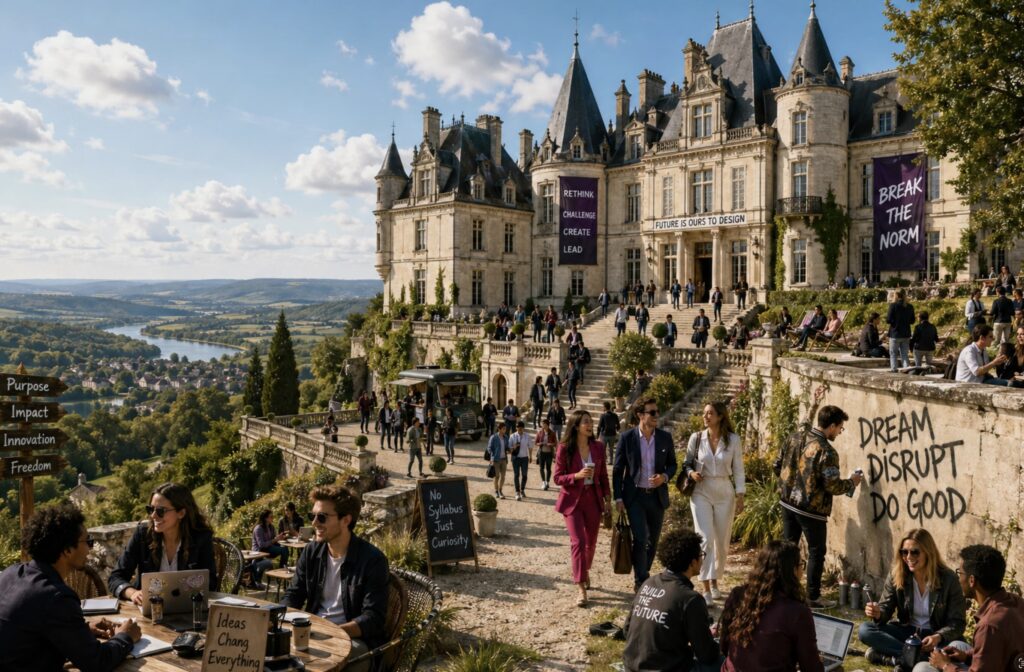
Education happens in motion – physical, intellectual, creative. This french château of ours stands as a rejection of the lecture hall orthodoxy that has calcified business education into credential theatre. We will build a business school where swinging from the ceiling is as legitimate as sitting at a desk, where plastering a wall teaches more about leadership than a case study, where professors are chosen for what they’ve dared, not just what they have published. Character precedes grades. Graduate conviction precedes institutional approval. The courage to change the world is forged, not taught.
We will not waste a single heartbeat pursuing accreditation committees’ approval. Our measures are singular:
Do our graduates look back with gratitude and transformation?
Do our professors and staff choose to stay because this place lets them do their best work?
Everything else is theater. These two metrics – graduate satisfaction and employee satisfaction – are the only accreditation that matters. If we serve those who learn here and those who teach here, we’ve succeeded. If we’ve merely impressed bureaucrats, we’ve failed entirely.
The accreditation system also tends to favour conformity over innovation
The accreditation system also tends to favour conformity over innovation. Business schools pursuing experimental teaching methods or unconventional program structures often find accreditation requirements actively work against them. The peer review process inherently reinforces what established institutions already do, making it harder for new models to emerge.
Meanwhile, teaching quality – the thing that actually matters to students – varies wildly among accredited programs. A professor can publish extensively and satisfy accreditation metrics while being a mediocre boring educator in the classroom or wherever the sessions will take place. That is why we will hire professors and supervisors who have an edge and have done something, and not just published. I couldn’t care less.
Instead, we will measure success through two groups who actually experience the institution: graduates and employees.
Alumni satisfaction after they’ve entered the workforce reveals whether the education delivered real value – better jobs, applicable skills, meaningful networks. Unlike accreditation’s focus on inputs, graduate ratings reflect outputs and outcomes.
Similarly, how professors and staff rate the school as an employer indicates whether we have built an environment that attracts and retains talented educators who are genuinely invested in student success rather than just credentialed bodies filling faculty requirements.
Accreditation functions as a risk filter that screens out diploma mills, and that matters. I don’t know how many times I have been punished when introducing new ways of learning or questioning if a business school is doing the right thing. I have often encouraged my student to protest and go on strike. They are paying customers and should be a lot more demanding than they actually are.
At the business school I will be starting up, I want the students to be rebellions also against the school and its leadership. They are the ones who will be responsible for the future societies and they can’t change them for the better by always being nice and conformist.
But among accredited business schools, quality differences remain enormous. We will build a business school that graduates enthusiastically recommend and where faculty genuinely want to work than one that impresses an accreditation committee. The former creates lasting value; the latter just creates paperwork. Gosh – life is too short for that.
We will not be an AI ghost
Most business schools seems to be jumping blindfolded onto the AI marketing caravan from the big tech companies. At our new business school, we will not do that. AI is a tool that should be kept under the same surveillance as nuclear weapons launch codes. That this is not happening was one on my main reasons writing « The Dangerous AI Gamble In Education »
We will focus on developing the students’ human abilities. As AI will make us collectively more stupid, our graduates will have unique skills for navigating through the jungle of blindfolded AI victims.
Is this business school idea something that resonates with you?
Then you should get in touch. Perhaps you are a professor who feel stuck in the current rigid system. Perhaps you are a brilliant communication and marketing talent who wants to help making this world a better place. Perhaps you are an investor who wants to support this exciting venture. Perhaps you are a journalist who wants to tell the story.
No matter who you are, Get in touch here





Recent Comments