
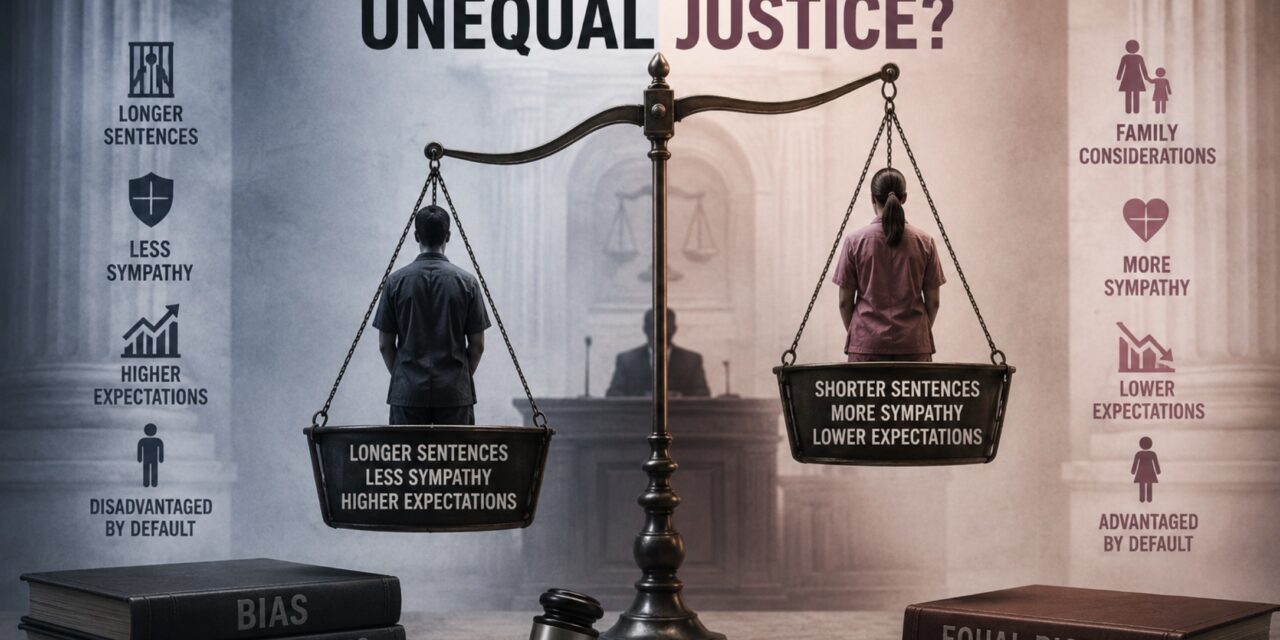
Across much of the Western world, justice systems present themselves as neutral, objective, and blind to gender. Yet a growing body of research suggests that men often receive harsher treatment than women for the same or similar crimes. While this remains an uncomfortable subject for many policymakers and commentators, the evidence increasingly points towards a troubling reality: men are frequently disadvantaged in modern legal systems.
Numerous sentencing studies from countries such as the United States, the United Kingdom, and Canada have found significant sentencing gaps between male and female offenders. Even when controlling for factors such as criminal history, severity of the offence, and likelihood of reoffending, men tend to receive longer prison sentences than women. In some cases, men are also more likely to be denied bail, less likely to avoid prison through plea agreements, and more likely to face harsher prosecutorial decisions.
Supporters of the current system often argue that these disparities can be explained by context. Women, on average, may have fewer prior convictions or may be less involved in violent offending. However, many studies already account for such differences and still find a measurable sentencing gap. This raises an uncomfortable question: if courts are meant to apply equal justice under the law, why should gender itself influence outcomes at all?
One explanation frequently discussed by criminologists is the so-called “chivalry hypothesis”. This theory suggests that judges, juries, and prosecutors may unconsciously view women as less dangerous, more vulnerable, or more capable of rehabilitation than men. Deeply rooted cultural attitudes often portray women as individuals in need of protection, while men are viewed as more responsible for their actions and less deserving of sympathy.
These attitudes may not always be deliberate or malicious. In many cases they are subtle and unconscious. Yet unconscious bias is still bias. If a male and female offender commit the same crime under similar circumstances, but the male offender receives a longer sentence because he is perceived as inherently tougher or less vulnerable, that represents unequal treatment before the law.
Family considerations also play a significant role. Courts are often reluctant to imprison mothers with young children, citing the impact on dependants and family stability. While compassion in sentencing is understandable, the same concern is not always extended equally to fathers. Many men are also primary caregivers or essential providers for their families, yet male defendants are less likely to benefit from such considerations.
The issue extends beyond sentencing alone. Men are significantly more likely to be stopped, searched, arrested, imprisoned, and subjected to force by law enforcement agencies. Prison populations in most countries are overwhelmingly male, and prison conditions themselves are often violent, overcrowded, and psychologically damaging. Public concern about these realities tends to be far more muted than discussions surrounding inequalities affecting women.
Critics of this argument sometimes respond that men commit more crime overall, particularly violent crime. While statistically true, this does not justify unequal treatment in individual cases. Justice systems are supposed to judge people as individuals, not as representatives of a demographic group. A legal system that punishes one person more harshly because of broader patterns associated with their sex undermines the very principle of equality before the law.
None of this means women never face discrimination in legal systems. They certainly can, particularly in areas such as domestic violence, sexual assault investigations, or family law disputes. However, acknowledging disadvantages faced by women should not prevent honest discussion about disadvantages faced by men.
True equality requires consistency. If society believes discrimination based on sex is wrong, then that principle must apply universally — even when the disadvantaged group happens to be male. A fair justice system should neither favour nor penalise individuals because of gender. It should judge actions, evidence, and circumstances alone.







Recent Comments